


Interview: Bringing The Karate Kid to the Stage
INTERVIEW:
BRINGING THE KARATE KID TO THE STAGE
How do you adapt a beloved and iconic film into a musical for the stage?
To find out, we sat down with the show’s two creators:
- Acclaimed writer Robert Mark Kamen (RK), who has written 23 major feature films, including The Karate Kid, partly based on his own life (he also owns and operates the Kamen Estate Wines vineyard in Sonoma, California);
- Drew Gasparini (DG), an award-winning songwriter, musical theatre composer, lyricist, playwright and performer.
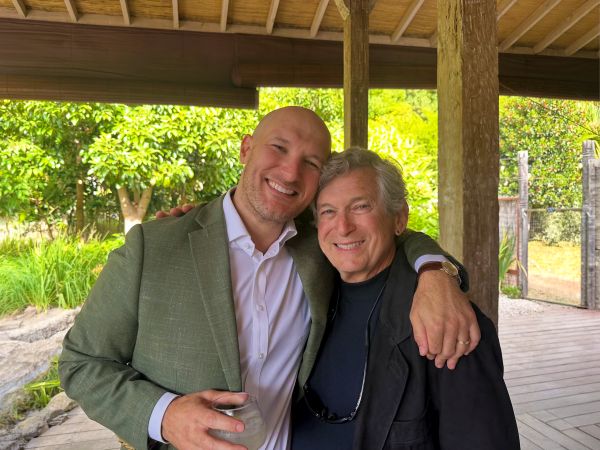 Drew Gasparini and Robert Mark Kamen
Robert, you are the creator of The Karate Kid, you’ve seen many incarnations of the IP, but when you were first proposed with the idea turning it into a musical, what were your thoughts?
RK: When our brilliant producer Kumiko Yoshii tracked me down in LA and presented the idea, my first thought was "Uh uh, no. No, no! This is a very bad idea. I am so not interested." Arigato. Have a nice day. A bottle of fancy burgundy, some very persuasive arguments, and three hours later, I signed on to her vision. Not only did she convince me to assign my co-shared (with Sony) separated rights over to her, but she also somehow convinced me, who knew nothing about how to go about writing a book for musical theatre, to write the book.
Drew, you’ve been composing in the New York theatre scene for a long time, tell us your initial thoughts on hearing about The Karate Kid as a musical.
DG: To be honest, I didn't see it immediately. But I decided to rewatch the movie and I was reminded of the beautiful story Robert wrote. I was seeing the movie through a new lens, and I saw this very meaningful relationship between a student and a teacher. It’s a story about two humans who are deeply lost in their respective lives and manage to find a connection. The layers in that story are ripe for song and I heard exactly how I'd write these characters. So, I submitted three songs and a month or so later I was in California meeting Robert.
What was it like getting ready to meet Robert for the first time?
DG: I loved our first meeting. I drove out to Robert's incredible home where I was, and continue to be, welcomed with open arms by Robert and his wife. We had a great lunch where he explained the entire message behind The Karate Kid. We had a terrific chat, lots of laughs, and then Robert allowed me to fanboy about another one of his movies, The Fifth Element, for about half an hour. It was a great day.
Since you both have a lot of experience creating, what were you looking for from each other?
DG: Every writing team is different and has a different flow, so I wasn't looking for anything other than a willing participant in making this show as great as we can, and Robert is that in spades. Ultimately, this is Robert's story and his legacy and the only thing that was important to me in our dynamic was making sure I was doing his story justice according to him. That mattered to me.
RK: I came to the process with no preconceived ideas I was open to everything, to anything. I just wanted a person who would write songs I would hum a day after I heard them.
How and where did you start the creative process in adapting The Karate Kid for the stage?
RK: I wrote the book before any songs were written. Drew showed up at our home, and stayed in our guest house and he just started writing songs. I would come down and listen, give my thoughts and then head back to my office and wait until he summoned me to listen to another song or a snatch of a song. We'd break for lunch and the same thing would go on until we broke for dinner.
DG: There were times where I'd stay in Robert's guest house for nights on end. We'd sit in his office, working through re-adapting the scenes to work for the stage, we'd break for lunch. We'd work a bit more, break for dinner (and wine), then I'd go back to the guest house and just crank out as many songs or song ideas as I could. I must've written 65 songs for this show over the course of its development. Sheesh.
You come from different artistic backgrounds. Did these differences help the process?
DG: I think Robert and I are constantly learning from one another. Movies and stage are so wildly different, so it was fun to see the world of theatre through Robert's eyes initially. I would go to Broadway shows with him every time he would visit NYC. I watched Robert fall in love with musicals. And now we call him "Bobby Broadway."
RK: Since Drew had more experience, I figured I just lay back and take his lead. That lasted all of ten minutes and I discovered that aside from form and structure all creativity, for me at least, comes from the same place. Does the work resonate. Is it real? Does it move me emotionally?
Robert, you’ve had an amazing career in Hollywood and entertainment, what was it like coming into the musical theatre space?
RK: I was such a newbie. I didn’t know where to begin. So, I asked our producer Kumiko Yoshii. She enrolled me in the “Kumiko crash course” in musical theatre. She sent me to see a musical a day, and little by little my skepticism melted away and was replaced by such unbridled enthusiasm, I couldn’t wait to start the writing process.
Drew, how did you approach the music composition for Mr. Miyagi?
DG: One of the great experiences of my life was being flown out to Okinawa to immerse myself in Miyagi's culture. I even studied alongside two amazing Okinawan songwriters who helped guide me. The instrumentation was important as well, so I did some writing for the Okinawan elements of our show on the sanshin, which is a three stringed instrument with a very specific sound. Luckily, Andrew Resnick and John Clancy, our arranger and orchestrator, knew exactly what influences to incorporate into the score.
Robert, what were your thoughts on hearing Drew’s first two songs?
RK: The first song (which ironically is no longer in the show) was called “Square One” and as soon as I heard it, I thought: "That is the essence of Daniel LaRusso, that is exactly what he is going through.” Drew really nailed it.
Robert, you were very much Daniel in your day, do you see yourself as Miyagi now?
RK: No! In my mind, I'm still Daniel, I still occupy an irreverent space, I own the space, but unlike that wimp who sprang out of my imagination, I've been studying Okinawan GoJu Karate for 61 years, and while we all need a Miyagi in our lives, for the self-defense part of what he as to teach, I'm good to go.
What would you say is your most rewarding takeaway from creating this musical?
DG: There are many rewards, being a part of this creative team. The education I've received simply by working on something so multicultural has been a major reward. Traveling to learn about the sides of Miyagi. To be a part of the legacy that Robert created is also something I don't take for granted. The Miyagi-verse consists of some of the most diehard fans (most of whom have accepted me graciously) and The Karate Kid takes up so much real estate in pop culture, it's truly humbling to be a part of something so big that continues to ripple out.
The Karate Kid – The Musical is the first show of the 2026/27 Main Mirvish Theatre Season. This Canadian Premiere production will play at the Princess of Wales Theatre from September 29 - November 1, 2026.